
ProductsDetails
Precision Progressive Stamping Die
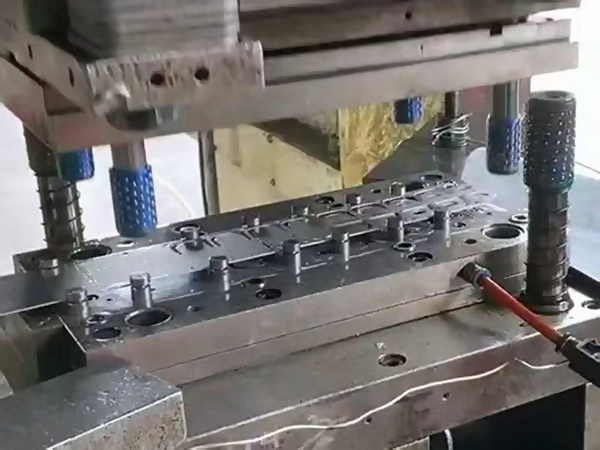
Precision progressive stamping die is a high-production press tool that carries a sheet metal coil strip through a sequence of stations, each performing one operation — piercing, bending, drawing, embossing, or cutting off. By the time the strip exits the die, a finished, ready-to-use component drops out. Progressive dies are the backbone of modern high-volume metal component manufacturing.
How Progressive Stamping Works
The press feeds a continuous coil of strip into the die at each stroke. At the first station, pilot holes are pierced. At the next station, a notch or a hole is cut. Subsequent stations add bends, emboss ribs, draw cups, or form flanges. The final station cut-off separates the finished part from the carrier strip. Guide pins engage the pilot holes at every station to maintain precise alignment.
Key Components
Die set with precision guide pillars and bushings for repeatable alignment.
Piercing punches and dies in hardened tool steel (SKD11, D2, or powder metallurgy steel).
Forming and bending stations with spring-loaded or nitrogen-gas pressure pads.
Stripper plate that holds the strip flat during each operation.
Pilot pins that locate the strip before the punches fire.
Cut-off station that separates the finished part from the carrier.
Advantages
Progressive dies produce parts at very high speed — often 200–1,200 strokes per minute on a high-speed press. Because all operations happen in one die, secondary operations such as separate piercing, bending, and tapping are eliminated. Labor cost per part is extremely low, and part consistency is excellent. The process is ideal for small to medium-sized parts made from thin strip (0.2 mm to 4 mm).
Applications
Progressive stamping is used in automotive manufacturing (brackets, clips, terminals, seat components), electronics (lead frames, connectors, shield cans), hardware (hinges, springs, fasteners), and consumer goods (zippers, battery contacts, motor laminations).
Design and Try-Out
Each progressive die is custom-designed based on the part geometry. The design team develops a strip layout that optimizes material utilization and station count. After CNC machining and heat treatment, the die is try-out on a mechanical press, and the first parts are measured against the drawing. Adjustments are made until all dimensions meet specification before the die is shipped.
Conclusion
A precision progressive stamping die is a capital investment that pays back quickly on high-volume parts. With proper preventive maintenance — regular sharpening, lubrication, and wear-part replacement — a well-built progressive die can produce tens of millions of parts.
 Recommended News
-
FRP Pultruded Profiles: Material Properties and Structural Design Guide
2026-07-06 12:00:00
-
SMC and FRP Compression Molding: Design Guidelines for Parts
2026-07-06 12:00:00
-
Cooling Tower Fill Media: Material, Design and Maintenance Guide
2026-07-06 12:00:00
-
Electric Sluice Gate: Types, Actuators and Application Guide
2026-07-06 12:00:00
-
Integrated Pump Station: What It Is and How to Select the Right Model
2026-07-06 12:00:00
Contact us
—— Contact:Ms. Wang
—— Tel:+86 19948391999
—— Email:JYFRP@outlook.com
—— Url:https://www.jinyanggep.com
—— Address:Zaoqiang County, Hengshui City, Hebei Province