
NewsDetails
FRP Pultruded Profiles: Material Properties and Structural Design Guide
author:Jinyang time:2026-07-06 00:00:00 Click:92
Pultrusion is a continuous process that pulls glass rovings, mat and fabric through a resin bath and a heated die to produce constant-cross-section FRP profiles. The result is a straight, strong, lightweight section with a smooth surface — I-beams, tubes, angles, rods, decking and custom shapes. Pultruded FRP is now a serious alternative to steel, aluminum and wood in corrosive and structural applications. This guide explains its properties and design rules.
How Pultrusion Works
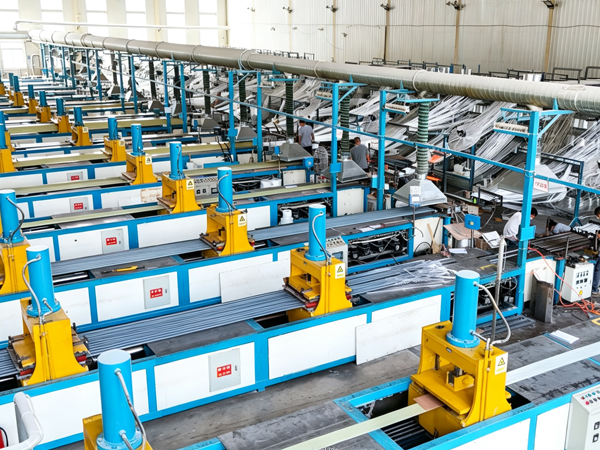
Continuous glass roving is pulled from creels, impregnated in a polyester or vinyl ester resin bath, preformed, and cured in a heated steel die. A flying cut-off saw cuts the profile to length. Because the process is continuous and automated, pultruded profiles are dimensionally consistent and competitive at long lengths, typically 6-12 m.
Key Mechanical Properties
| Property | Typical Value |
|---|---|
| Tensile Strength (longitudinal) | 600-1000 MPa |
| Flexural Strength | 300-600 MPa |
| Flexural Modulus | 20-40 GPa |
| Density | 1.8-2.1 g/cm³ |
| Coefficient of Thermal Expansion | ~10×10⁻⁶ /°C |
| Max Continuous Temperature | ~120°C (polyester), 180°C (vinyl ester) |
Common Shapes and Uses
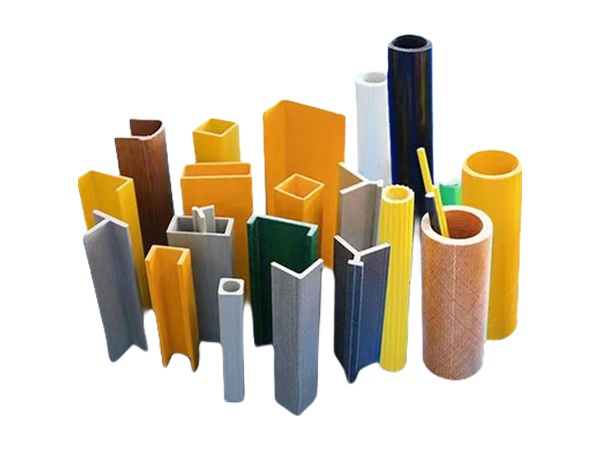
Standard pultruded shapes include round tubes, square tubes, I-beams, H-beams, angles, channels, flat bars, rods, ladder rails, handrails and deck planks. They are used in structural framing, industrial walkways, cable trays, utility poles, antenna masts, window and door frames, and cooling tower supports. Polyurethane-pultruded profiles offer an even smoother, more UV-resistant surface for outdoor architectural use.
Design Guidelines
Pultruded FRP is anisotropic: strength along the pultrusion direction is much higher than across it. Design loads should therefore be applied along the length. Deflection, not strength, usually controls design; a typical limit is span/200 for beams. Connections should use stainless steel bolts with neoprene or FRP washers to avoid point loading; never weld to FRP. Add edge distances of at least 2× bolt diameter to prevent splitting.
Advantages vs. Steel and Wood
| Metric | Pultruded FRP | Steel | Wood |
|---|---|---|---|
| Weight | ~1/4 of steel | Heavy | Light but weak |
| Corrosion | Excellent | Rusts | Rots |
| Maintenance | None | Paint | Treat / replace |
| Thermal / Electric | Insulator | Conductive | Insulator |
| Fire | Can be flame-retardant | Non-combustible | Combustible |
Conclusion
Pultruded FRP profiles give engineers a strong, lightweight, corrosion-resistant section for long-life structures in hostile environments. Hebei Jinyang Environmental Protection Equipment Co., Ltd. produces standard and custom pultruded FRP and polyurethane profiles, including handrail systems, grating support beams and structural sections, with cut-to-length delivery.
References
ASTM D3918 — Standard Test Methods for FRP Pultruded Reinforced Thermosetting Plastics
 Recommended Products
 Contact us
—— Contact:Ms. Wang
—— Tel:+86 19948391999
—— Email:JYFRP@outlook.com
—— Url:https://www.jinyanggep.com
—— Address:Zaoqiang County, Hengshui City, Hebei Province